"Data from the Sun" (Analyzing solar imagery)

Speaker Rafal Angryk being introduced.
Last night, the Atlanta Data Science Meetup hosted a talk by Dr. Rafal Angryk on analyzing solar data (solar event imagery, to be precise). Dr. Angryk has a computer science background and recommends reading Fourth Paradigm (free from Microsoft). He conducts solar imagery research at Georgia State University's Institute for Insight, which is a multi-disciplinary center for advancing analytics. Here are my notes from this very interesting topic.

The analysis and prediction of solar storms from solar imagery is relevant for several reasons. Particles emitted by the Sun are responsible for northern and southern lights. During a solar storm, authorities have two minutes to reach, or the intensity of the particle radiation can reach levels hazardous to:
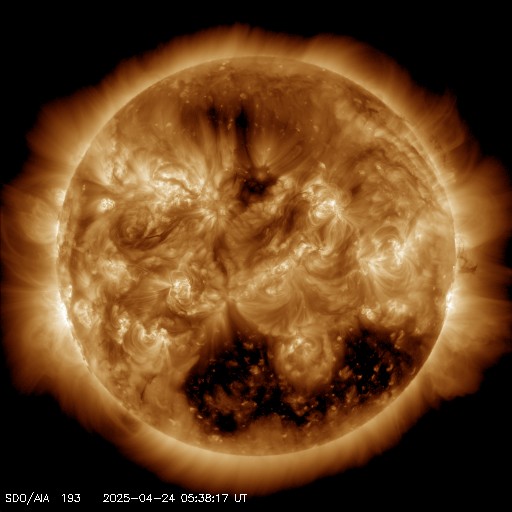
Solar surface image (source: NASA/Solar Dynamics Observatory)
Solar imagery comes from the Solar Dynamics Observatory, in both raster and vector formats. 150GB of imagery are produced every day. Dr. Angryk's group extracts parameters from these images, 6 months at a time, performs dimension reduction, then indexes the findings (k-nearest neighbors or kNN index) for comparison. Over 180,000 features have been identified over 5 years of data.

Dr. Angryk's lab created imagefarmer.org to find whether a shot of the sun is similar to similar to a database of existing photographs. This opens the possibility of comparing a computer-generated Sun image to real photos.

The keys to define features and similarities are: (i) content and (ii) time sequence. Typically, features of the Sun surface are defined by their center (location) and curvature (extent). Features are then linked in time to create a temporal "signature" of an event. Some events last 30 minutes, others last 12 days. Noise is filtered out to avoid erroneous results. The resulting dataset is thus multidimensional.

By extracting and sequencing the features of solar images, it becomes possible to predict the evolution of a solar event and inform the authorities so they can protect people and assets from solar storms. Dr. Angryk hopes he can use image analysis to foster collaboration between the teams specialized in solar observation with teams specialized in the physical modeling of the Sun's activity.

One could also imagine the technology developed in our day-to-day life. The cited example would be a completely personalized shopping experience, where shoppers presented with a choice of similar items according to their taste.

YPT Panel on Renew Atlanta Infrastructure Bond Referendum [Update: Passed 9:1]

Shot I took of the panel discussion. From left to right: Rebecca Serna (Atlanta Bicycle Coalition), Sally Hammock (PEDs), Jalal Slade (City of Atlanta), Kwanza Hall (Atlanta City Council), and Tom Weyandt (Moderator).
[Update] The bond referendum passed by a 9:1 margin. Nice to see Atlanta moving forward with infrastructure upkeep.

On March 5, 2015, YPT Atlanta (Young Professionals in Transportation) hosted a panel discussion on the upcoming Renew Atlanta Infrastructure Bond Referendum. The event was held at the Metro Atlanta Chamber. with a good turnout (25 pers). The Twitter handle is #RenewATL. Early voting is under way for the referendum, which date is March 17, 2015 (St. Patrick's Day). The municipal bond is a $250 million package to modernize a sizeable portion of Atlanta's roads, bridges, facilities, and more. If approved by Atlanta residents, the bond will be solely funded by existing city taxes over 20 years. 

Here are my summary notes from the event, paraphrased and in no particular order: 
  • Tom Weyandt, Transportation Policy Advisor for Atlanta Mayor Kasim Reed, introduces the panel.
  • Jalal Slade, City of Atlanta Senior Real Estate Advisor, describes the main highlights of the bond:
    • The bond addresses $250 million out of about $1 billion of infrastructure upgrade backlog. The amount was selected for it's balanced impact on the city's finances.
    • There will be two separate questions on the ballot:
      • a $180 million allotment for transportation (roads, bridges, sidewalks, complete streets with bike lanes, traffic signal synchronization),
      • a ~$84 million allotment for facilities (parks, fire and police stations).
    • The project list will be finalized during the weeks after referendum passage, before actual bond issuance.
    • Oversight may be similar to the management in place for Atlanta Airport.bonds.
  • Kwanza Hall, District 2 Council Member, provides additional details:
    • 2/3 of the bond amount will be for city-wide projects (~$134 million for transportation, $44 million for facilities).  
    • The remainder will be for local projects.
    • A small amount will be available to each City Council member for small fixes, and as buffer to complete or "top-off" projects that affect a particular district. Hall mentioned about the MLK Natatorium, once used for Olympic trials.
    • Maturity of the bond is 20 years, and will be repaid using existing city taxes.
    • City tax revenue is high enough to make bond an attractive option. 
  • Sally Hammock, PEDs CEO, explains a drawback of the bond project line up:
    • Only $5 million have been allocated for sidewalks, vs. the $40 million planned initially (sidewalks cost the city $15 million/year). 
    • Sidewalks tend to be seen as add-on to large projects rather than priority projects.
    • Sidewalk maintenance could be added to the city's annual budget. She references a Georgia Tech study on the state of sidewalks to quantify the current needs.
  • Rebecca Serna, Atlanta Bicycle Coalition (ABC) CEO, explains the transportation opportunities:
    • A chance to rebalance modes, especially bikes and foot traffic.
    • ABC has an objective of 15% allotment for "complete streets" in the project list. The actual fraction is about 13%, which is very close to the objective. The transformation of DeKalb Ave. using the complete streets approach will be the flagship project for bikers.
    • Improved infrastructure such as new bike lanes must connect together rather than form a patchwork.
    • The projects under this bond should be used as credit for future bonds.
  • A topic on funding expansion is brought up by the moderator and the audience:
    • Budgeting serves short-term projects better rather than 20-year projects.
    • Rebecca Serna suggests levying parking fees.
    • Kwanza Hall suggests figuring out how to attract economic development to the city and into existing buildings. He mentions incentives for students to remain after college, and the low occupancy of Bank of America Tower in Midtown Atlanta.
  • Q&A session
    • A resident mentions about Lee Street improvements, in Southwest Atlanta (near West End). There is an advocacy group for that corridor, however it is unlikely that Lee Street will be included in the bond project list.
    • A Georgia Tech student asks about transit projects. Unfortunately there are none, however transit buses will benefit from road projects.
    • A resident asks about financing after the bond matures. The answer from Kwanza Hall leaves may ideas open, most notably a 3% capex line in the city budget, property sales (Underground Atlanta, will provide capital and operational revenue). He also mentioned partnering with energy companies to promote building efficiency. It is still a "best bang for the buck" attitude.
    • The panelists are asked about the tally after votes are cast. The panelists expect a large win.

Transportation: Attitudes changing in Georgia Legislature

Via AJC.com

This article from Atlanta Journal Constitution highlights the changing attitudes of the Georgia Legislature towards transportation. Rural lawmakers, once reluctant to provide state funding for transit and transportation investments, are moving a $1 billion transportation funding bill for overdue projects...

Fw: DistribuTECH 2015: What's the killer app for the smart grid? There isn't one.

Via UtilityDive

This post from UtilityDive.com sums up why there is no consensus about a "killer app" in the power distribution industry, and I agree with the statements.

From my personal experience, a few years ago, companies large and small set on discovering what was the equivalent of Facebook in the power distribution world. As you reflect on the needs that utilities want to address, the outcome boiled down to a few sets of narrow needs, such as "how to I track asset usage", "who is not paying his bills", or "where are customers suffering power outages." When the industry gets solid solutions to these questions, I think time will come to research the next big opportunities.

My Snowpocalypse story, one year late(r)

There is a Winter Storm Watch for Monday, Feb. 16, 2015 in Georgia, calling for a snow forecast! Speaking of snow, I never got a chance to write about my experience during 'Snowpocalypse' in January 2014. So here is my story, one year late(r).

The media announced heavy snowfall for Tuesday afternoon, Jan 28, 2014. Like everyone else, I went to work that morning; however, knowing that snow would cause significant delays in the afternoon, I decided to leave my car home and take the bus to work. CCT's express reverse commute took me comfortably to the office in Cobb County, in the Wildwood complex.
From the late morning to afternoon, here is the rough sequence of events as I can recall:
  • Snow was already falling by 11am. Some managers advised employees they could leave early.
  • By noon, traffic on Powers Ferry Road was already completely stopped.
  • At 2pm, I started watching traffic conditions for getting home. Already, one bus remained in the Kennessaw area for two hours. A few colleagues sent email updates over their phones saying traffic around the office was paralyzed.
  • By 3pm, it became obvious that there would be no afternoon reverse commute service.
    I focused on two options:
    • Spending one night (or three in hindsight) at the office, with limited supplies, etc.
    • Walking to the Cumberland Mall Transfer Center and try to catch a bus from there. 
  • At 4pm, I left the office and started walking in the snow to Cumberland Mall.
  • At 5pm, I arrived at Cumberland Mall.
  • Left Cumberland Mall by 5:30pm at reduced speed.
  • Arrive to Midtown around 6:45pm.
Many cars were stuck on local and arterial roads when I left office. Show was fresh and soft, but that was enough to cause stalls even on the slightest incline.

Snowpocalypse shot I took on Windy Ridge Parkway.

It is a 45 min walk to the mall, but walking was definitely faster than driving. When I arrived on Cobb Parkway, I thought I would stop for coffee and warmth, and surprise... both Starbucks and Dunkin Donuts were closed! I figured managers let their employees leave early as well, so I proceeded to the mall. 
I saw people checking in at the Sheraton Hotel adjacent to Cumberland Mall, possibly due to the weather. I hoped the mall would be still open, but when I arrived, employees were directing people out and closing the mall. I thus proceeded to Cumberland Transfer Center, which is also adjacent to the mall but opposite the hotel. A few dozen people were waiting there, some for three hours already. No CCT buses were to be seen, however.
Shot I took at Cumberland Transfer Center - Stay close to stay warm!
After waiting a few minutes, I wanted to check on the bus situation online and decide whether to wait or to walk home (a 7-mile walk). I went to a nearby Barnes and Noble store to attempt to connect to WiFi.

On my way to the bookstore, hope returns! A MARTA bus #12 approaches. You could hear people cheering their relief as the bus approached to take everybody back to Midtown Atlanta. We proceeded to board the bus. The driver waived all fares given the unusual conditions. The bus soon left at slow speed. Thank you MARTA!

There is hope! Shot I took boarding the bus to Midtown.
The bus driver made an unusual turn and took the freeway instead of the local roads. Freeway conditions were only slightly better. Traffic was mostly clear to Midtown, and completely stopped to the suburbs. Many cars were stalled or abandoned on the shoulder or across multiple lanes. For us on the bus, the most perilous part of the journey was the freeway ascent to From West Paces Ferry to Moores Mill. Fortunately, the bus cleared the ascent without encountering too much ice. The rest of the trip was relatively smooth, and we arrived in Midtown safely. 
I was lucky I made it home in less than three hours. Other people were less fortunate and slept in their cars, at their office, or at grocery stores. Quite a few others walked several miles home, in the snow, including those living near stops that were skipped by the bus. Tons of gas were lost in stalled cars and stopped traffic, and many more work hours not worked the following days. I was really lucky I made it home!
Traffic Map Tuesday night (GDOT)
Traffic Map Wednesday morning (GDOT)
The positive news is that people walking on the street the following days were cheering the snow and the quietness of the inner Atlanta city.
Following up "Snowpocalypse" were two events I know of that held debate on city readiness to snow storms:
  • Congress for New Urbanism (CNU)
  • Atlanta Magazine
With Monday's sleet mix in the forecast, let's see how much progress was made since last year.


Random quote

"Renewable energy is most vulnerable to the very problems it seeks to avoid."
 (from IEEE Power & Energy, May-June 2013, found in my old notes)

Fw: Government warns US could fall behind in transportation tech

Via Engadget, USDOT

Video source: USDOT.

Today, Engadget revealed a USDOT case study that points out the lack of investments in transportation technology in the U.S., and that concerns all modes of transportation: automobile, rail, transit, and air travel. Find more at the links above and check out the DOT videos!

Fw: Georgia's stance on climate change? Head in the sand


(image credit: epa.gov)
My recent posts (forwards, rather) all dealt with climate change one way or the other. For today, I share with you an article that best pictures the reaction of conservative politicians of the Georgia Legislature to the idea of climate change. Some conservative lawmakers may find these basic facts useful. Then read the author's point concerning topics such as... Education... Transportation... Enjoy the article!